
A typical litter size is around 4 to 6 puppies, although cavapoo litter size can vary quite a bit. A litter of 2 to 8 puppies is possible, with occasional individual cases falling outside this litter range. There is no reliable way to know the exact number of puppies before pregnancy monitoring. It gives you a clearer picture but the actual number can be lower or higher.
Several litter size factors can influence the litter, including the maternal size, age, overall health, genetics, parent breeds, and whether it is her first pregnancy.
A smaller Cavapoo may have fewer puppies than a larger female, while a healthy adult at her prime age may have a different litter than a very young or older mother. These differences are normal, which is why litter sizes vary even among otherwise healthy dogs.
It is also worth remembering that there is no correct number of puppies for every Cavapoo. In this litter size guide, you will learn why litter size varies and what factors give you a better idea of what to expect from a possible litter size rather than relying on expectations.
How Many Puppies Does a Cavapoo Have?
Typically a cavapoo has 4 to 6 puppies per litter. However, cavapoo litter size is not fixed, roughly 2 to 8 puppies is a possible litter size depending on the individual mother and her circumstances.
A litter of four or five puppies is comfortably within the expected range, and considered ordinary rather than unusual. On the smaller side, two or three puppies would simply be a smaller litter. At the other end, seven puppies or eight puppies would be toward the larger end.
Sometimes litter can fall outside this range, but those individual cases should not be treated as typical. This is one reason it is better to think in terms of a range rather than expecting one exact number of puppies from every Cavapoo litter.
There is another detail that is easy to overlook: the same Cavapoo can have a different number of puppies during different pregnancies. A female might have five puppies in one litter and a different number the next time. Her size, age, health, genetics, parentage, and whether it is her first litter are all factors that can contribute to this variation.
A Cavapoo can even have one puppy, which is known as a singleton litter. It is much more uncommon than having several puppies, but it is certainly possible. So, when you try to predict the size of a particular Cavapoo’s litter, room for natural variation should leave rather than assuming every pregnancy will produce the same result.
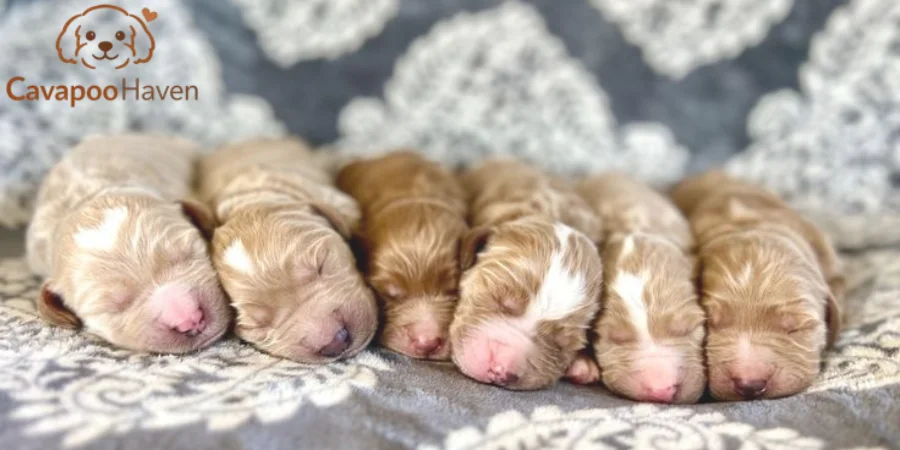
What Is the Normal Cavapoo Litter Size?
For most Cavapoos, 4–6 puppies is a usual range and it is the number which most of the people expect but litter size naturally varies when thinking about how many puppies a Cavapoo may have. A litter of two or three puppies can be possible, smaller-than-typical litter, while seven or eight puppies would be on the larger side.
A one puppy litter, known as a singleton litter, is uncommon but possible, while more than nine puppies would be considered unusually large and may occur only in individual cases.
Here’s a simple way to put the numbers into perspective:
| Litter size | What it generally means |
| 1 puppy | Singleton litter; possible but uncommon |
| 2–3 puppies | Smaller-than-typical litter |
| 4–6 puppies | Typical/common range |
| 7–8 puppies | Larger litter |
| 9+ puppies | Unusually large; individual cases can occur |
This table is best viewed as a general guide, not a definitive rule. The numbers are simply a helpful perspective on litter size. Individual Cavapoos can have a different litter size during different pregnancies, even when they have the same mother or similar breeding hitter can vary, so there is no dependable way to predict the exact number before the pregnancy is properly assessed.
The below detailed discussed factors can all help explain why two cavapoos have different litter size.
What Factors Affect How Many Puppies a Cavapoo Has?
There isn’t one factor that determines how many puppies a Cavapoo will have. The mother’s size, age, health, genetics, parentage, and breeding history can all play a part. Even then, these factors can only give you an idea—they cannot predict an exact litter size.

The Mother’s Size
One of the most important factors to consider is the mother’s size. A larger female generally has greater physical capacity to carry a litter than a very small female, which can influence Cavapoo litter size and overall litter capacity.
A larger mother does not automatically mean she will have more puppies. Litter size can still vary from one pregnancy to another pregnancy, so natural litter size variation is possible even when comparing females of similar size.
In other words, the mother’s size is an important part of the picture, but it is only one of several things that can influence a Cavapoo’s litter. This is one reason you may notice differences between Cavapoos of different sizes, although size alone does not determine the final number of puppies.
Whether the Cavapoo Has Toy or Miniature Poodle Parentage
The Cavapoo mother’s eventual size can be influenced by whether her Poodle parentage comes from a Toy or Miniature Poodle.
Obviously a larger Cavapoo may have greater potential to carry more puppies than a physically small female but it is not the thumb rule. However, size influence is only one piece of the puzzle. It is important not to use Toy or Miniature Poodle parentage alone to predict the litter size.
The Mother’s Age
A female Cavapoo’s age can influence her reproductive performance and, in turn, her litter size. Very young and older females may have different litter sizes compared with a healthy adult during her prime breeding years.
However, there isn’t one exact age when a Cavapoo will produce the most puppies. Age is simply one factor among several factors, and each individual female can have a different reproductive history.
Looking at her overall health, breeding background, and previous reproductive performance gives a more useful picture than focusing on age alone. This can help explain why two otherwise similar females may have different results when it comes to the number of puppies they produce.
The Mother’s Health and Condition
A mother’s overall health matters throughout pregnancy and influences reproductive success. When preparing for a litter, her general condition, nutrition, maternal health, and any existing health problems are important factors to consider.
Good pregnancy health helps support a pregnancy and gives a healthy Cavapoo a better foundation for carrying her litter. Still, being healthy doesn’t guarantee a large litter. A healthy Cavapoo can have two to six puppies, or another number altogether.
Genetics and Family History
Genetics can play a role in litter size, and a Cavapoo’s parents and family history may offer useful clues about what to expect but not a guaranteed number. In other words, genetic influence contributes to prediction, but exact number gets after pregnancy monitering.
This shows that litter size is not determined by appearance alone; natural litter size variation can occur even among closely related dogs and those with similar physical traits.
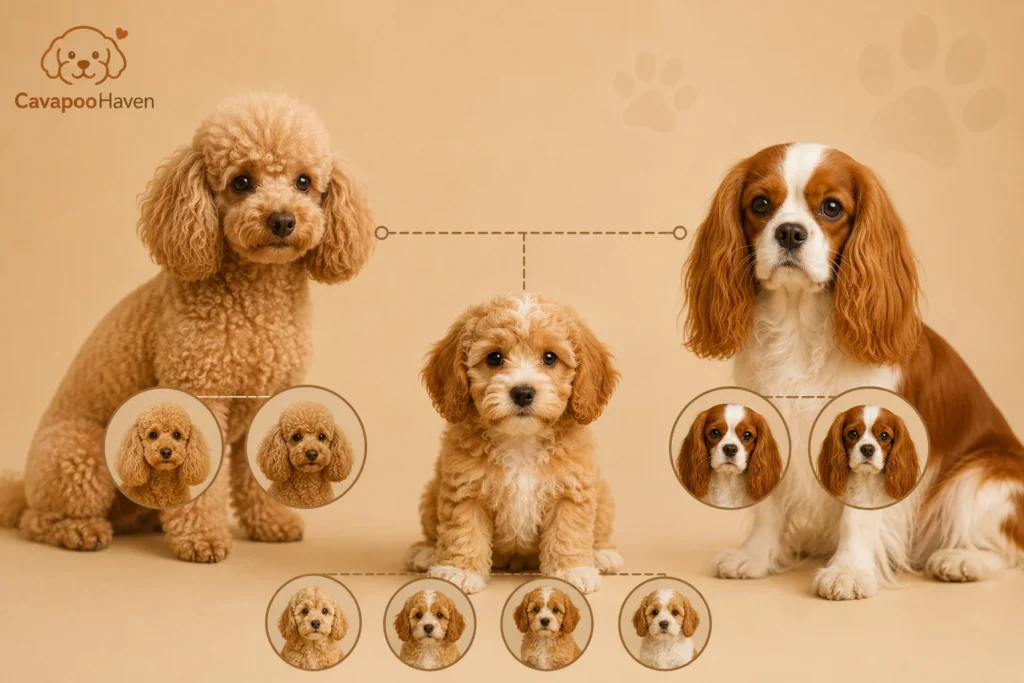
First Litter vs. Later Litters
A Cavapoo’s first litter may not be the same size as her later litters, and litter size can naturally change from one pregnancy to another. However, this rule does not apply for every female.
Same females can have different numbers of puppies in two different pregnancies. A first-time mother could still have a typical-sized litter, while another Cavapoo may have more puppies in her first pregnancy.
Rather than assuming a first litter will be smaller or later litters will be larger, these factors can help explain differences in litter sizes and may contribute to the outcome but shouldn’t be considered as a guarantee.
Generation and Parentage
You may wonder whether an F1, F1b, or another Cavapoo generation affects litter size a female will have. These generation terms describe how the puppy’s parents are related to the Cavalier King Charles Spaniel and Poodle breed, but the generation alone cannot provide a reliable litter-size prediction.
For litter-size expectations, the more useful considerations are individual mother’s size, health, age, genetics, and breeding history. These considerations can help shape an expectation and collectively lead you to predict a specific outcome.
Why Do Cavapoo Litters Vary So Much?
Cavapoo litter size can vary because there isn’t one single factor controlling the litter size. Several factors work together in this regard. There is no simple formula that can tell you exactly how many puppies a Cavapoo will have.
Even the same Cavapoo may have different-sized litters during different pregnancies, such as five puppies one time and a different number during a later pregnancy.
A previous litter can provide useful context, but it should not be treated as a firm prediction for the next one. Likewise, two Cavapoos that are similar in size can produce different numbers of puppies, even when their physical traits appear similar. This natural litter variation reflects individual variation rather than a fixed rule.
Can a Cavapoo Have Only One Puppy?
Yes, a Cavapoo can have only one puppy. When one puppy or a single puppy is born in a litter, it is called a singleton litter. Although this is possible, it is less common than having several puppies.
A typical Cavapoo litter is around 4–6 puppies, so a singleton litter is well below the usual number expected. A breeder example that was documented showed a Cavapoo that gave birth to a single puppy, confirming that this can occur in real-world breeding.
However, one small litter does not automatically mean something is wrong. Litter size can vary naturally between individual pregnancies, and a small litter alone is not enough to determine whether the mother or puppy has a health problem.
If your Cavapoo is expecting one puppy, pregnancy monitoring is still important. This can help confirm pregnancy and provide a clearer picture of the pregnancy outcome and what to expect as the due date approaches.

Can a Cavapoo Have 8 or More Puppies?
Yes, a Cavapoo can have 8 or more puppies, but this would be considered a larger-than-usual litter rather than the norm. The typical range is 4–6 puppies, while a litter of seven or litter of eight is toward the higher end of what you might expect.
Larger litters are possible, but most Cavapoos will not necessarily have eight puppies, so an eight-puppy litter is quite different from the typical litter size.
There are occasional reports of even larger litters, including 10 puppies, which can rarely occur. If you mention this unusual possibility, it is better to present it as an exception rather than a normal Cavapoo litter size.
If your Cavapoo is expecting eight puppies, don’t assume that the number itself is abnormal. However, a larger litter size can place greater demands on the mother and developing puppies, making veterinary monitoring especially important throughout pregnancy and around delivery.
How Many Puppies Can a Cavapoo Safely Carry?
There isn’t a single number that can be called a safe maximum for every Cavapoo. A mother’s size, overall health, age, and the number of puppies and size of puppies developing during pregnancy can all influence her carrying capacity.
A smaller Cavapoo may have less capacity for carrying a large litter, while a larger healthy female may easily be able to carry more. However, body size alone does not make a bigger litter automatically safe.
The number of puppies is not the only thing that matters. An unusually large litter can place greater demands on the mother and increase delivery or pregnancy challenges, making an otherwise manageable pregnancy more difficult.
Every pregnancy is different, so pregnancy variation is expected. Simply counting the puppies cannot tell you whether a particular pregnancy is progressing safely or whether the litter size is appropriate for that mother.
If you know or suspect your Cavapoo is carrying a large litter, veterinary monitoring is the safest approach. A veterinarian can use veterinary imaging and examinations to assess pregnancy, evaluate maternal health, and identify potential concerns before delivery. This is especially important when there are concerns about litter safety, pregnancy safety, or delivery safety.
So instead of asking for the maximum number of puppies a Cavapoo can safely carry, it is more accurate to ask whether a particular mother can safely carry her particular litter. There is no universal safe maximum due to variation in factors. A veterinarian is the right person to make that assessment and determine whether the pregnancy can be managed safely.
How Can You Find Out How Many Puppies a Cavapoo Is Having?
If you have a pregnant Cavapoo, as a responsible breeder, you don’t necessarily have to wait until birth to get an idea of litter size. An ultrasound by veterinarian can help confirm pregnancy and give you a useful view of the developing puppies and their fetal development instead of an idea.
An ultrasound can show whether the pregnancy progression is progressing normally, but it may not always provide a perfectly accurate puppy count. As the stage of pregnancy advances, fetal position and the position of puppies can make it difficult to count them accurately.
It’s best not to count puppies yourself at home. Your veterinarian can select the appropriate method, provide proper veterinary care, and interpret results safely based on the reports. Just remember that an estimated puppy count should be treated as an estimate rather than a guarantee.
Later in pregnancy, your veterinarian may recommend further diagnostic imaging to get a better idea of the expected litter size so that you can deal with the pregnancy more smoothly and in a better way.
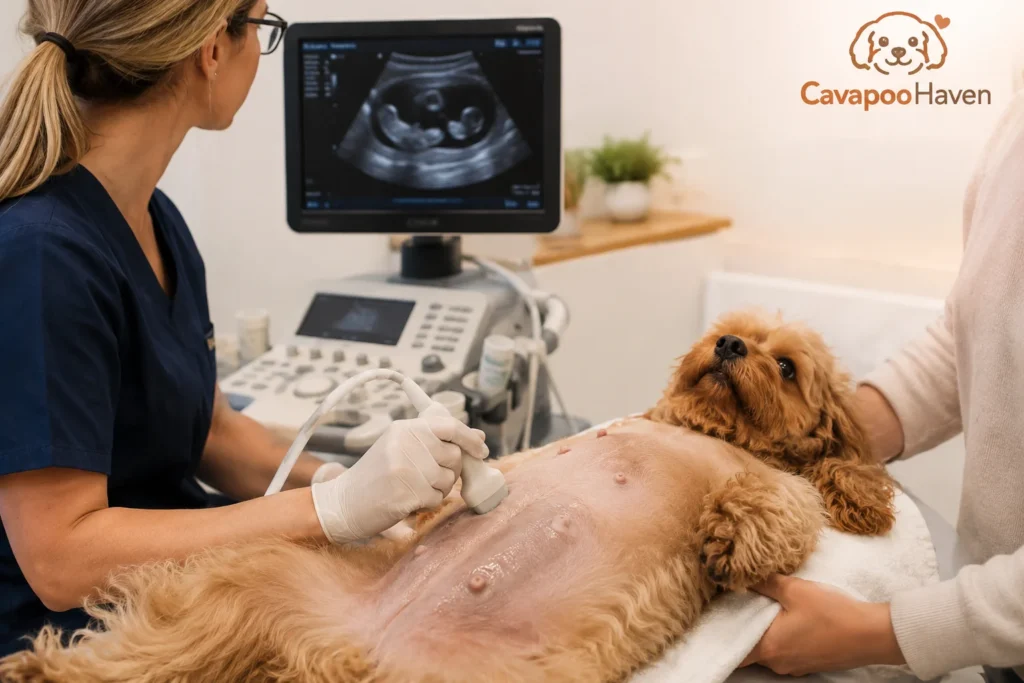
When Can You Tell How Many Puppies a Cavapoo Is Having?
The timing of a pregnancy check matters when you want to know the litter size. Confirming pregnancy and estimating litters are two different things, and the best method can depend on how far along the pregnancy is.
An ultrasound can be useful for pregnancy confirmation and checking the developing puppies, but it may not provide an exact puppy count because puppies can be difficult to distinguish from one another as pregnancy progresses.
Later in pregnancy, your veterinarian may recommend some diagnostic examination for a better estimate of the litter size. This can be especially useful as the due date approaches, because knowing whether you’re expecting a small or large litter, allows better preparation for delivery.
Even with veterinary imaging, the expected litter size should remain an estimate, not a guaranteed count. Puppies can overlap or be positioned in ways that make counting difficult.
If knowing the litter size estimation is important, your veterinarian can recommend the right timing and method for your Cavapoo. The practical progression is simple: confirm the pregnancy first, estimate the litter size at the appropriate stage, and use veterinary guidance to prepare for delivery rather than relying on estimates.
Does Father’s Size Affect Cavapoo Litter Size?
The father’s size can be part of the overall picture, but it does not determine litter size. During pregnancy, the mother’s size, reproductive health, and her ability to carry a litter generally have a greater influence.
The dam is the mother, while the sire is the father. It is the mother’s body that is carrying and supporting the developing puppies, so her physical size, health, age, and reproductive history are especially relevant.
The father still matters genetically. His genes contribute to the puppies’ inherited characteristics and traits. So, If you’re trying to estimate litter size, look more closely at the mother’s size, health, age, genetics, pregnancy health, and previous litters rather than using the father’s size as a predictor.
What Happens If a Cavapoo Has a Large Litter?
A large litter can place more demands on the mother, especially during pregnancy and while nursing. A large Cavapoo litter does not automatically mean there will be a problem, but the mother and puppies may need closer attention.
One important concern after birth is competition for milk. When many puppies are nursing at the same time, some may struggle to get enough milk, particularly smaller or weaker puppies compared with their littermates.
This is why keeping an eye on each puppy is so important. Regular weight monitoring can show whether individual puppies are gaining weight and keeping up with the litter. A puppy falling behind may need closer attention.
The mother’s condition should also be watched as well. If there are concerns during labor, an unusually large litter, or problems with nursing etc, veterinary supervision is the safest approach.
A Cavapoo litter can turn out perfectly well, but it should not be judged by the puppy count alone. The mother’s condition and the puppies’ progress are much more useful indicators of how things are going.
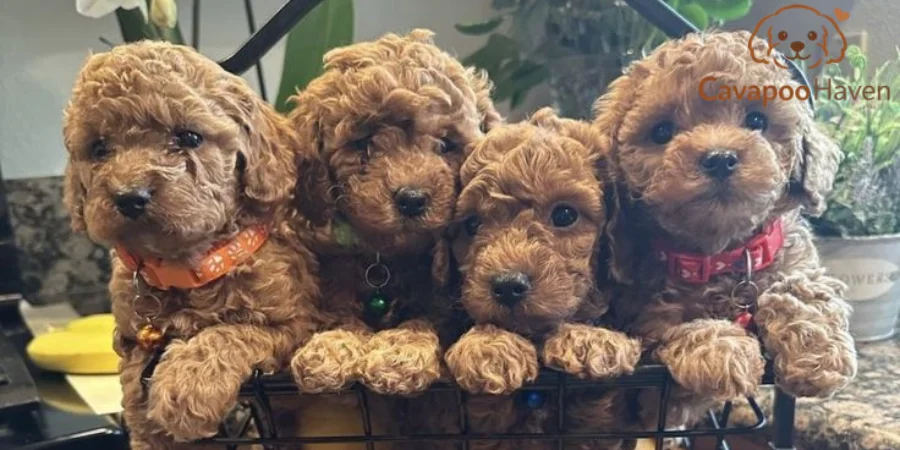
How to Tell if Newborn Cavapoo Puppies Are Doing Well
With a Cavapoo large litter, keeping an eye on each individual puppy is especially important. Regular observations become problems noticeable before they become serious.
Weight gain is one of the clearest things to monitor. Healthy newborn puppies should generally be gaining weight, not losing weight. Weighing each puppy regularly can help you spot one that is falling behind its littermates.
This is particularly important with large litters, where puppies must compete for their mother’s milk. A smaller or weaker puppy may need closer attention to make sure it is nursing properly and gaining weight properly.
Newborn puppies also need to stay warm and comfortable. Very young puppies have a limited ability to regulate body temperature, so their nesting environment should be kept appropriately warm without creating a risk of overheating.
If a puppy isn’t gaining weight, appears unusually weak, struggles to nurse, or simply doesn’t seem right, contact your veterinarian promptly and seek professional advice rather than wait and see because changes happen quickly with newborn puppies.
Does Litter Size Affect Cavapoo Puppy Size?
Litter size can influence puppy size, but a large litter does not mean smaller puppies. A Cavapoo may have differences in birth size and development depending on how many puppies share the same pregnancy.
In a larger litter, there may be less space and fewer available resources during puppy development, which can contribute to differences in birth size. However, litter size influence is only one part of the picture, and a small litter does not guarantee larger puppies.
Genetics are also important. A puppy inherits characteristics from both parents, so parents’ size and genetics all affect puppy size and influence growth. Two puppy siblings from the same litter can still have different sizes, even though they share the same pregnancy and available resources. Their inherited characteristics, genetic influence, and natural growth variation can lead to different outcomes..
So, think of litter size as one piece of the picture, rather than a reliable predictor of expected size. The relationship between larger litter size, smaller litter size, puppy size variation, and growth variation is real, but it is not simple enough to say that more puppies always means smaller puppies.
How Long Is a Cavapoo Pregnant?
A Cavapoo is usually pregnant for about 63 days, or roughly 9 weeks, from ovulation. Still, the exact length of pregnancy can vary by a few days, so the due date is better viewed as an estimate rather than an exact countdown.
Several factors can affect pregnancy timing, including the individual dog, when ovulation occurred, and the mother’s size and health. Because mating date and ovulation do not necessarily occur at the same time, counting only from the mating date may not provide an accurate due date.
If your Cavapoo is pregnant, regular veterinary monitoring is important. A veterinarian can help with pregnancy confirmation, estimate pregnancy stage, and monitor puppy development. This also helps you better understand the likely delivery timing and know what to expect as the birth gets closer.
What Should You Expect From a Cavapoo Litter?
A Cavapoo litter generally begins with pregnancy, followed by veterinary confirmation, an estimated litter size, and eventually birth. For most owners, the exciting part is knowing what to expect without becoming too focused on a specific number.
Once pregnancy is confirmed, a veterinarian can estimate litter size and give you a better idea of how many puppies to expect as pregnancy progresses. Just remember this estimate can flactuate particularly during early pregnancy.
After the puppies are born, careful monitoring becomes more important than simply counting puppies. Each newborn should be checked for breathing, nursing, staying warm, and gaining weight, while puppy health, and puppy development are monitored.
A healthy mother and healthy newborns are the real signs of a successful Cavapoo litter and a healthy litter outcome.

Frequently Asked Questions
How many puppies does a Cavapoo have on average?
A Cavapoo typically has 4–6 puppies per litter. However, litter size can vary depending on the various factors which are discussed above in detail.
Can a Cavapoo have 2 puppies?
Yes. A Cavapoo can have 2 puppies, although this is smaller than the typical litter size. A small litter does not necessarily indicate a problem if the mother and puppies are healthy.
Can a Cavapoo have only one puppy?
Yes. A Cavapoo can have only one puppy in a singleton litter, which means only one puppy is born. This is uncommon, but it can happen.
Can a Cavapoo have 8 puppies?
Yes. 8 puppies is possible and falls toward the higher end of the commonly reported range. Larger litters may be more demanding for the mother, so veterinary care is especially important during pregnancy, delivery and after delivery.
Can a Cavapoo have 10 puppies?
It is possible for a Cavapoo to have 10 puppies, but this would be considered unusual rather than the typical range. Litter size can vary considerably between individual dogs and pregnancies.
Do Toy Cavapoos have smaller litters?
Not necessarily. Smaller Cavapoos may have smaller litters because the mother’s size can influence how many puppies she can safely carry, but Toy Cavapoos do not automatically have fewer puppies. There is plenty of individual variation.because size is the only factor in litter size.
Do Mini Cavapoos have bigger litters than Toy Cavapoos?
Not necessarily. A larger mother may have the potential for a larger litter, so Mini Cavapoos may sometimes have more puppies than smaller Cavapoos. However, being a Mini Cavapoo is not a bigger litter guarantee, because other factors also play a role in litter size.A larger mother may have the potential for a larger litter, so Mini Cavapoos may sometimes have more puppies than smaller Cavapoos. However, being a Mini Cavapoo does not guarantee a bigger litter. Other factors also play a role.
Is the first Cavapoo litter usually smaller?
A first litter can be smaller in some female Cavapoos, but this is not a fixed rule. A first-time mother may have a litter that is smaller, average, or even relatively large.
Can the same Cavapoo have different litter sizes?
Yes. The same Cavapoo can have different litter sizes during different pregnancies. One pregnancy might result in four puppies, while another could produce six or more.
How can I find out how many puppies my Cavapoo is carrying?
A veterinarian can evaluate the pregnancy using ultrasound or other imaging methods. Imaging can help estimate the number and development of the puppies, although an early estimate may not always be exact.
What is considered a large Cavapoo litter?
A litter of 7–8 puppies would be toward the higher end of the commonly reported range for Cavapoos. Larger litters are possible, but they are less typical and may require closer veterinary monitoring.
What is a singleton Cavapoo litter?
A singleton litter is a pregnancy in which only one puppy develops and is born. It is uncommon in Cavapoos, but it can occur. Because a single puppy may affect the normal timing and progression of labor, veterinary guidance is particularly important.
Is it safe to get a puppy of first time pregnant cavapoo?
Yes, it is absolutely safe to get a cavapoo puppy of first time pregnant cavapoo mother, if mother is healthy, get proper vaccination and care, and is atleast one year old.
Final Thoughts
A Cavapoo typically has 4–6 puppies per litter, with a broader commonly reported range of around 2–8 puppies. A single puppy can also occur as a singleton, while larger litters are possible but less typical.
The exact number depends on several factors, including the mother’s size, age, health, genetics, parentage, and previous litter history. A previous litter history can provide useful context but every pregnancy is different, so there is no single number that can accurately predict how many puppies a particular Cavapoo will have.
If your Cavapoo is pregnant, the most reliable way to understand her individual pregnancy is through veterinary monitoring and appropriate imaging. Rather than focusing only on the final puppy count, make sure the mother and developing puppies are progressing safely and receiving proper care.